How a rural cancer center is expanding access and changing lives
For many cancer patients, the phrase “clinical trial” can feel intimidating — something reserved for large academic medical centers in major cities.
But at Self Regional Healthcare’s community cancer center in Greenwood, oncology physicians are working to change that perception by bringing clinical research, innovative treatment options and hope directly to the patients who need them most.
Clinical trials have transformed cancer treatment and are the foundation of many of the most important advancements in cancer care. Through carefully controlled research, physicians determine whether new therapies are safer or more effective than existing treatments. Those discoveries eventually become the treatments available to patients everywhere.
Dr. Joanna Metzner-Sadurski, MD, a medical oncologist who has spent more than two decades caring for patients in Greenwood, has seen firsthand how research can transform lives.
“Without clinical trials, there is no improvement. There is no immunotherapy, no new discoveries, no better treatments,” she said.
Since arriving in Greenwood in 2002, Dr. Sadurski has worked to ensure patients understand that clinical trials are not a last resort, but an opportunity to consider additional treatment options while contributing to the future of medicine.
The practice has been built on trust,” she says. “Participation is completely voluntary and our goal is always to help patients make the treatment decision that is right for them.”
That focus on education and access has helped the practice increase participation among diverse patient populations. In 2015, the cancer center received recognition for minority participation in clinical trials and, more recently, Self Regional Healthcare received a Gold Certificate of Excellence from the National Cancer Institute’s Community Oncology Research Program for exceptional achievement in clinical trial enrollment.
A key part of that success has been helping patients better understand their options. The practice developed Oncology101.org, an educational resource designed to help patients understand clinical trials, the informed-consent process and an educational video about treatment options before making a decision. “Patients are much more willing to participate when they understand it,” Dr. Sadurski said.
She emphasizes the importance of including people from different backgrounds in this research.
“If we don’t have data from different populations, we cannot know whether treatments work equally well for everyone,” Dr. Sadurski said. “A medication may work very well overall, but we need to understand how it performs across different groups, including both benefits and side effects.”
BUILDING RESEARCH OPPORTUNITIES IN A COMMUNITY SETTING
Creating a successful clinical trial program outside a major academic medical center comes with unique challenges. Community oncology practices often have fewer resources, smaller research teams, and limited staff who are dedicated solely to clinical trial operations.
At Self Regional Healthcare, the team manages the same rigorous requirements as larger research institutions while allowing patients to receive advanced care close to home.
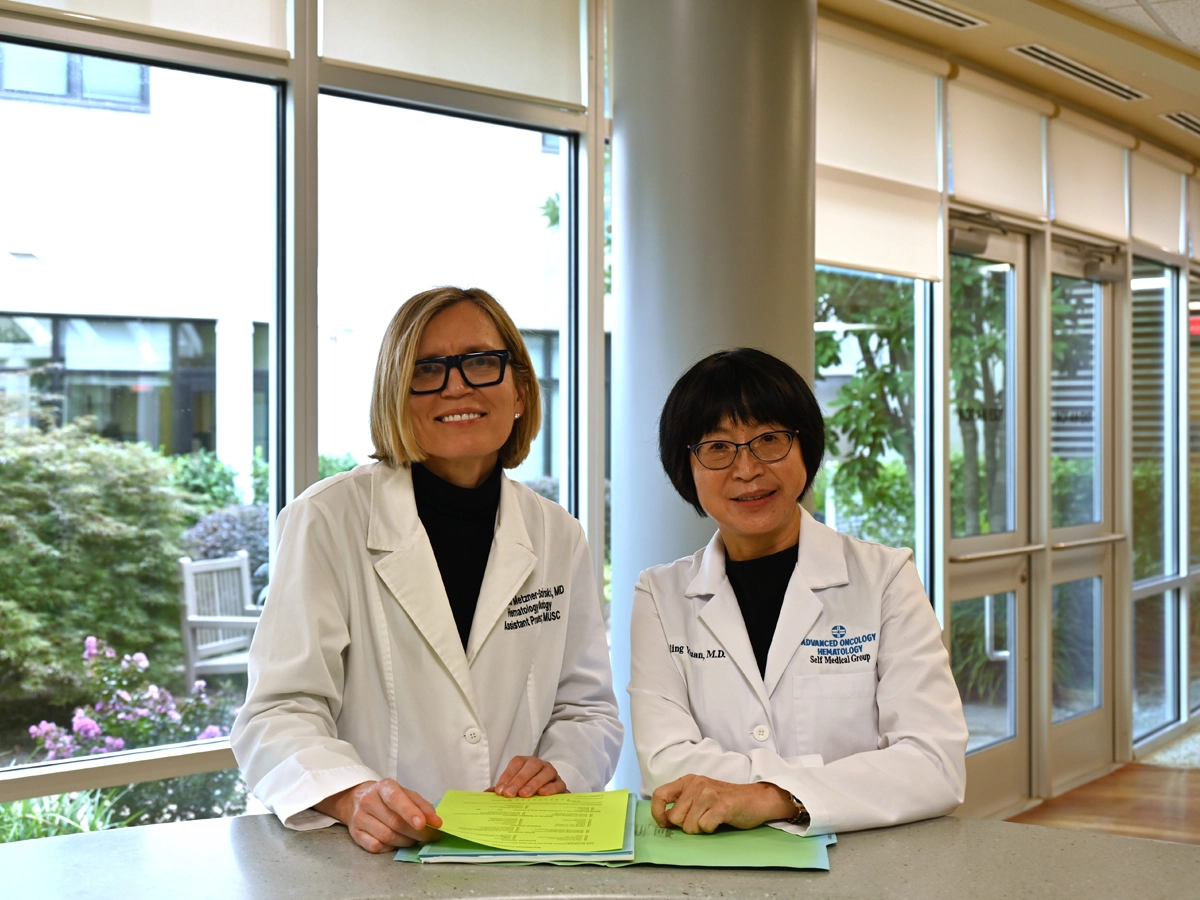
The clinical trials program is led by Dr. Sadurski and Dr. Ruiling Yuan, who has worked alongside her for 11 years.
“Today’s research is my patients’ treatment tomorrow,” Dr. Yuan says.
She credits Dr. Sadurski’s dedication to research and community oncology as one of the reasons she chose to continue building the program in Greenwood.
“We empower each other to go above and beyond for our patients.” she says.
Clinical trials require careful attention to detail. Even with their nimble team, every laboratory value, scan, and eligibility requirement must be carefully reviewed before a patient can enroll.
“Every box must be checked,” said Dr. Sadurski.
The physicians credit partnerships with academic institutions, including the Medical University of South Carolina, with helping make community-based research possible.
THE POWER OF NEW TREATMENTS
The impact of clinical trials can be seen in the lives of patients whose outcomes once seemed impossible.
Early studies of immunotherapy, including KEYNOTE-001, helped demonstrate the potential of pembrolizumab (Keytruda) and contributed to a new era of treatment for patients with advanced cancers.
Dr. Sadurski recalls one patient who arrived with stage IV melanoma that had spread to her bones and was unable to walk without crutches. After treatment, she had no evidence of disease, returned to work as a nurse, and resumed the life she had before cancer.
“Those stories give you goosebumps because you see what these treatments can do,” said Dr. Sadurski.
Another example is an older patient with advanced lung cancer who experienced a serious complication after beginning immunotherapy and required hospitalization. Years later, that same patient has no evidence of disease and continues traveling in retirement.
Many patients benefiting from today’s breakthroughs were not enrolled in the original studies themselves. Instead, they are benefiting from discoveries made possible because other patients participated in research years earlier.
Dr. Sadurski and Dr. Yuan advocate for clinical trials beyond their own community, working with the South Carolina Medical Association and policymakers to highlight the importance of rural oncology, research funding and access to care. They travel to Washington, D.C. to advocate with policymakers for clinical research, cancer research funding, and access to high-quality cancer care in rural communities.
Their message is simple: Clinical trials, whether in major cities or smaller communities, are more than a pathway to advancing cancer care today — they are an investment in the lives of patients tomorrow.