
Highlighting a “Lightbulb Moment”
Knowing that physicians turn to the gastroenterology team for minimally invasive endoscopic management of challenging cases gives Dr. Mark Cromer, a gastroenterology fellow at Prisma Health, a sense of immense fulfillment.
“It is exciting to be able to offer patients an endoscopic procedure after unsuccessful surgical intervention or when risks of surgery are prohibitively high,” he said. “Sometimes those situations lead to innovative treatment with meaningful outcomes.”
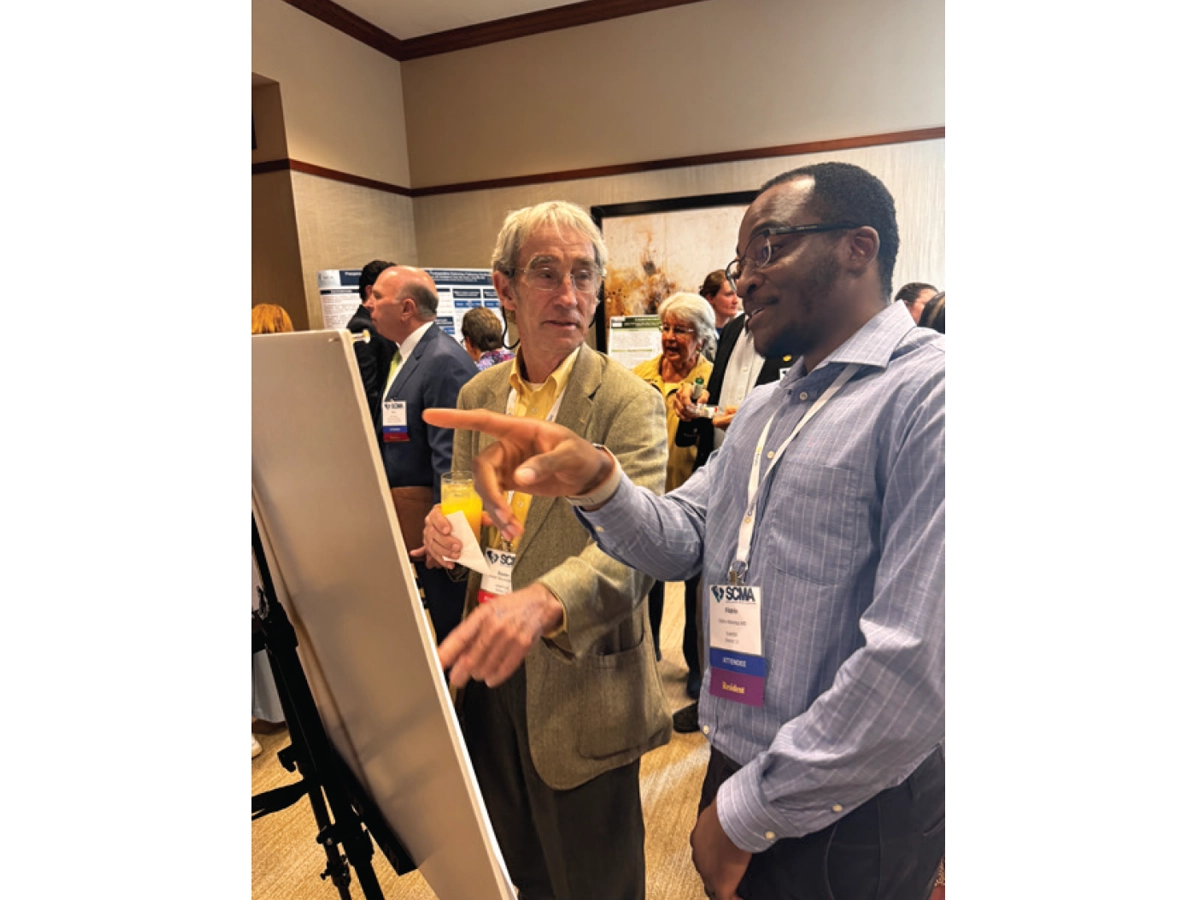
Dr. Cromer shared one successful outcome of a novel endoscopic procedure in his poster presentation at the SCMA’s Annual Meeting last year. He was one of many medical students, residents, and fellows from all over the state who shared their medical research – research that often opens doors to cutting-edge treatments and better patient care.
Titled “The ‘Lightbulb Moment:’ Performing Gastrobulbostomy for a Malignant Gastric Outlet Obstruction,” his presentation highlighted a unique approach to a procedure that offered physical and emotional comfort to a patient during their final days of life and peace for their family members.
The patient was a 51-year-old woman with a newly-diagnosed aggressive gastric adenocarcinoma who presented with abdominal pain, abdominal distension, and intolerance of oral intake, according to Dr. Cromer’s description of the case. Abdominal imaging showed new large volume ascites with suspected metastatic peritoneal disease, and a distended, debris-filled stomach with minimal contrast flow into the duodenum consistent with a malignant partial gastric outlet obstruction.
Given her symptom burden and advanced malignancy, a minimallyinvasive endoscopic ultrasound-guided gastroenterostomy (EUSGE) was successfully performed. This procedure enables gastric contents to bypass an obstructing malignant tumor by connecting the stomach to the small intestine with a metal stent, which in turn allows patients to resume eating and drinking by mouth.
“The traditional approach for an EUS-GE is to connect the stomach to the distal duodenum or proximal jejunum (lower intestine) because of the straighter trajectory when placing the stent and creating the connection,” Dr. Cromer explained. “That approach was not feasible in our patient’s case because the abdominal ascitic fluid was separating the target portion of the small intestine from the stomach. Instead, we were able to connect the stomach to the duodenal bulb (upper small intestine), hence the name ‘gastrobulbostomy.’”
The stent was successfully placed, there were no complications from the procedure, the patient’s obstructive symptoms resolved, and they were able to resume eating and drinking. Dr. Cromer’s case demonstrated that performing a “gastrobulbostomy” when altered anatomy precludes the traditional approach for an EUS-GE can be a safe and effective option for the palliative relief of symptoms related to a malignant gastric outlet obstruction.
“This is a rewarding procedure for both the patient and the physician. There is immense fulfillment in seeing the rapid improvement of patient’s symptoms and demeaner when the unpleasant nasogastric tube is removed and they can resume eating and drinking without fear of pain, nausea, or vomiting,” said Dr. Cromer.
Further studies have demonstrated that EUS-GE provided faster relief of symptoms with shorter hospital stay, lower complication rates, and lower cost for patients with malignant gastric outlet obstruction when compared to surgical intervention,” he also noted.
Other Prisma Health gastroenterology and hepatology physicians who collaborated on the case included:
• Juan Corral, MD — clinical assistant professor for the University of South Carolina School of Medicine – Greenville. Dr. Corral was the primary endoscopist and attending physician for the case.
• Kalpit Devani, MD — director of endoscopy and clinical assistant professor for the University of South Carolina School of Medicine – Greenville. Dr. Devani is Dr. Cromer’s research mentor who was a consulting colleague for the case and developed the idea for the novel approach.
• Varun Moktan, MD — current advanced endoscopy fellow at Atrium Health in Charlotte, N.C. Dr. Moktan was a Prisma Health gastroenterology fellow at the time who assisted with the case.
Not long after the SCMA Annual Meeting and poster competition, the American College of Gastroenterology (ACG) selected “The ‘Lightbulb Moment:’ Performing Gastrobulbostomy for a Malignant Gastric Outlet Obstruction” as a Presidential Poster Recipient for the 2025 Annual Scientific Meeting that was held in Phoenix, Arizona.
This distinction is awarded to approximately five percent of the nearly 6,000 abstracts reviewed, recognizing high-quality and novel research, according to the ACG.
“It’s exciting to talk with colleagues and be a part of a showcase that reminds physicians what we can do with certain tools,” Dr. Cromer said as he reminisced about last year’s poster competition at the SCMA Annual Meeting.
“It is incredible to have the poster presentations as a forum that celebrates all the hard work statewide,” said Dr. Kathryn Anne Potter, chair for the SCMA Young Physician Section who has been integral in this year’s poster presentations. “Working with residents and medical students is part of my job that really gives me joy.”
The Young Physician Section is a “nice little community,” Dr. Potter added. “It is gratifying to be a part of the group and to bring research and CME experiences to training physicians. Others are always welcome.”
Anyone who attends the annual meeting can judge posters and receive CME credit. This year’s case reports and original research will be separated for judging and the judging rubric has been reformulated.
“The new rubric should increase interactions during the poster presentations and highlight how well each presenter knows their subject, as well as the novelty and the impact of their work,” explained Dr. Potter.
2026 Poster Presentation
The 2026 Poster Presentation Session will be held during the 2026 SCMA Annual Meeting on Friday, April 24 from 5-6:30 p.m. at the at the Charleston Marriott. You’re Invited!
There will be Young Physician Section, Resident and Fellow Section, and Medical Student Section Meetings from 6:30-7:15 p.m., immediately following the poster competition.