
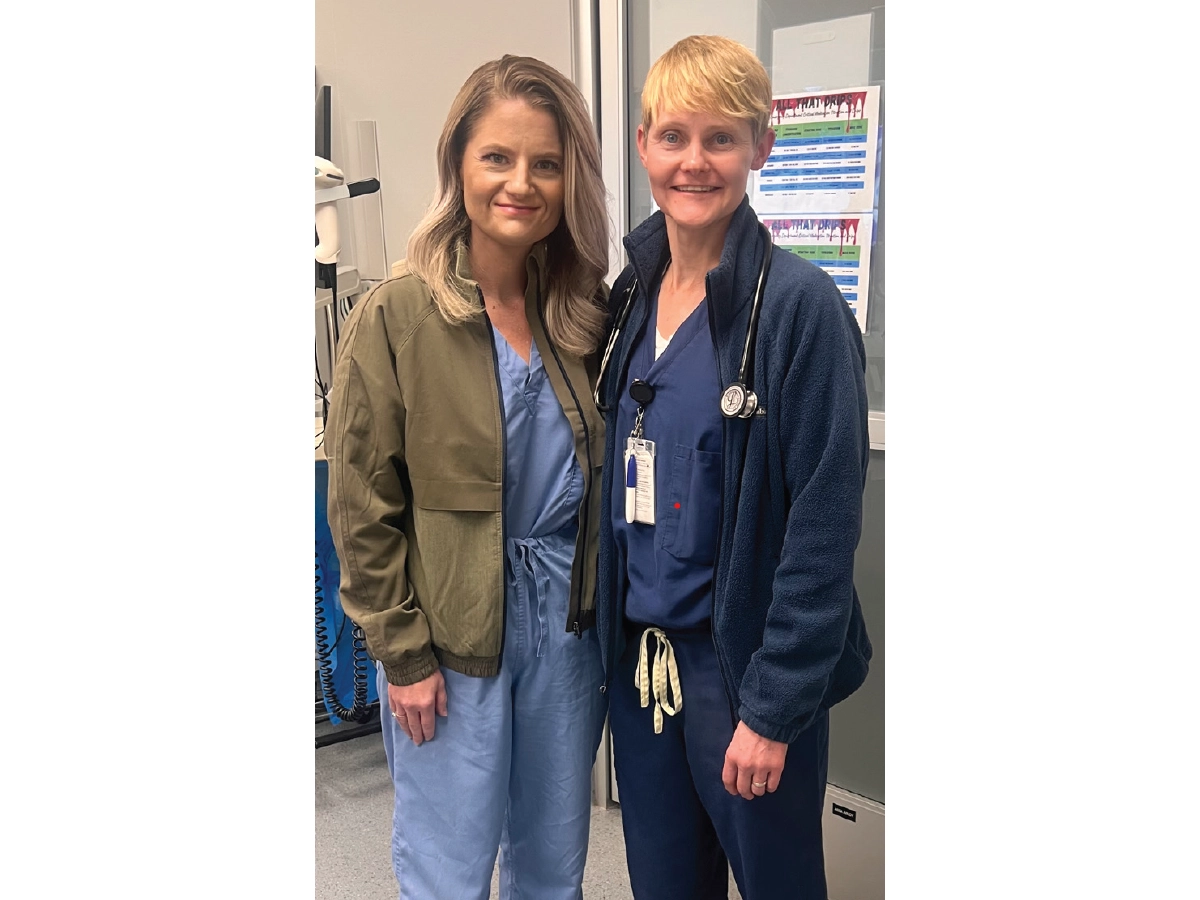
Employing a Team Approach in the Provision of Care
Dr. Dawn Zellner knows firsthand of the dangers that the passage of two South Carolina Senate Bills could cause.
Senate Bill 44 and Senate Bill 45, being considered this session, would essentially alter healthcare delivery in the state. The bills would allow advanced practice providers (APPs), including nurse practitioners (NPs) and physician assistants (PAs), to practice independently of physicians, drawing concern from physicians and the public.
In recent surveys conducted by Starboard Communications, a public affairs and political consulting firm in Lexington, a staggering 95 percent of South Carolinians believe it’s important for a physician to be involved in their diagnosis and treatment decisions and 74 percent believe that if there are changes made to the scope of practice contained in S.44 and S.45, medical and practice procedures would be less safe.
In 2022, at age 42, Dr. Zellner was diagnosed with colorectal cancer. As chief of staff and medical director of emergency services at Bon Secours-St. Francis Downtown Medical Center in Greenville, she felt fortunate that she could receive care at her hospital. But, early on, a mishap occurred that could have drastically changed the outcome of her treatment.
She was informed via email that her white blood cell count had plummeted, but her APP cancelled her chemotherapy.
“I said, ‘No, that’s not what’s happening,’” said Dr. Zellner.
After rounds of chemotherapy and radiation, she is cancerfree.
But the situation begs the questions, “what if she was not a physician” or “what if a physician wasn’t involved in her care?”
In her individual case, Dr. Zellner had the background to spot the error and raise the issue, but if an APP were practicing without a collaborating/supervising physician in another case, the outcome could easily have been far worse.
Dr. Zellner asserts that APPs are invaluable to the team effort necessary to provide optimal patient care. Like many physicians in the state, Dr. Zellner remains thankful for the expertise, care, and value they bring to patients in South Carolina.
“Physicians are uncomfortable even discussing this issue because it feels as if the professions are pitted against one another when they should be operating as a team,” said Dr. Zellner. “However, for the sake of all patients, we do not believe that the training and education NPs and PAs receive prepare them to practice independently without the benefit of physician collaboration or supervision.”
Even with the 2,000 hours of required post-graduate clinical hours stipulated in S. 44 and S. 45, the education, training, and experience of PAs and NPs do not come close to reaching the levels required to complete a doctor of medicine or doctor of osteopathic medicine program. Physicians spend four years in medical school and up to nine years in a medical residency program, with 12,000-16,000 hours of clinical training.
Moreover, PAs and NPs may and often do switch between specialties, unlike physicians, and thus may not be as experienced in their areas of practice, necessitating more oversight from a physician focused on the discipline.
Any legal issues that may arise from an APP misstep, like the one Dr. Zellner experienced, are the full responsibility of the physician heading the team.
“Every member of a healthcare team is essential,” continued Dr. Zellner. “Diverse training, individual roles, contributed talents, and shared accountability are necessary for all parties to operate collaboratively. When new or complicated scenarios arise, splitsecond decision making is required or a patient presents with a condition beyond the competency of the NP or PA, it is essential that the most highly-trained member – the physician – is leading the team and available for consultation to avert disaster, keep costs as low as possible, maintain the highest quality of care, and protect public safety.”
Dr. Zellner wants to see APPs reach the top level of their profession and does her part through mentorship to contribute to their growth. She spends time teaching sessions for APPs at the hospital and includes them in detailed case reviews to increase their knowledge and understanding, especially in the emergency department.
“It is a healthcare team,” she said. I can’t do my job without them. I also don’t think that they can do their job without me.”
The South Carolina Medical Association encourages physician advocates who have been personally impacted by these issues to reach out to their legislators and voice their opposition to S. 44 and S. 45.
Thoughts from a PA
After suffering a broken ankle in an accident, Jaimie Garland needed X-rays and immediately became interested in joining the medical field. She went to school to become an X-ray technologist, and while working at St. Francis – where she first met Dr. Zellner in 2013 – she observed the team-based relationship between APPs and physicians.
“I thought, I would like a larger role in the healthcare field, but I don’t want to be a doctor,” said Garland. “I’ve always loved the emergency department, but I know it has a high burnout rate and I thought, I could always work in an ER and if I ever needed to leave, I could switch to another specialty without having to go through a re-boarding process.”
She continued, “You learn on the job and you’re there with physician support, so I thought that’s what made the most sense to me, and I’m glad that I did it because it does leave me lots of options without having to spend six-to-eight years in school.”
Like Dr. Zellner, patient safety is at the center of all care delivered by Garland.
“I personally don’t think I would feel comfortable if any of my family members or my spouse was seeing an APP that had no conversation and no relationship with the supervising physician, and that’s with me being somebody who’s in the medical field,” said Garland.