
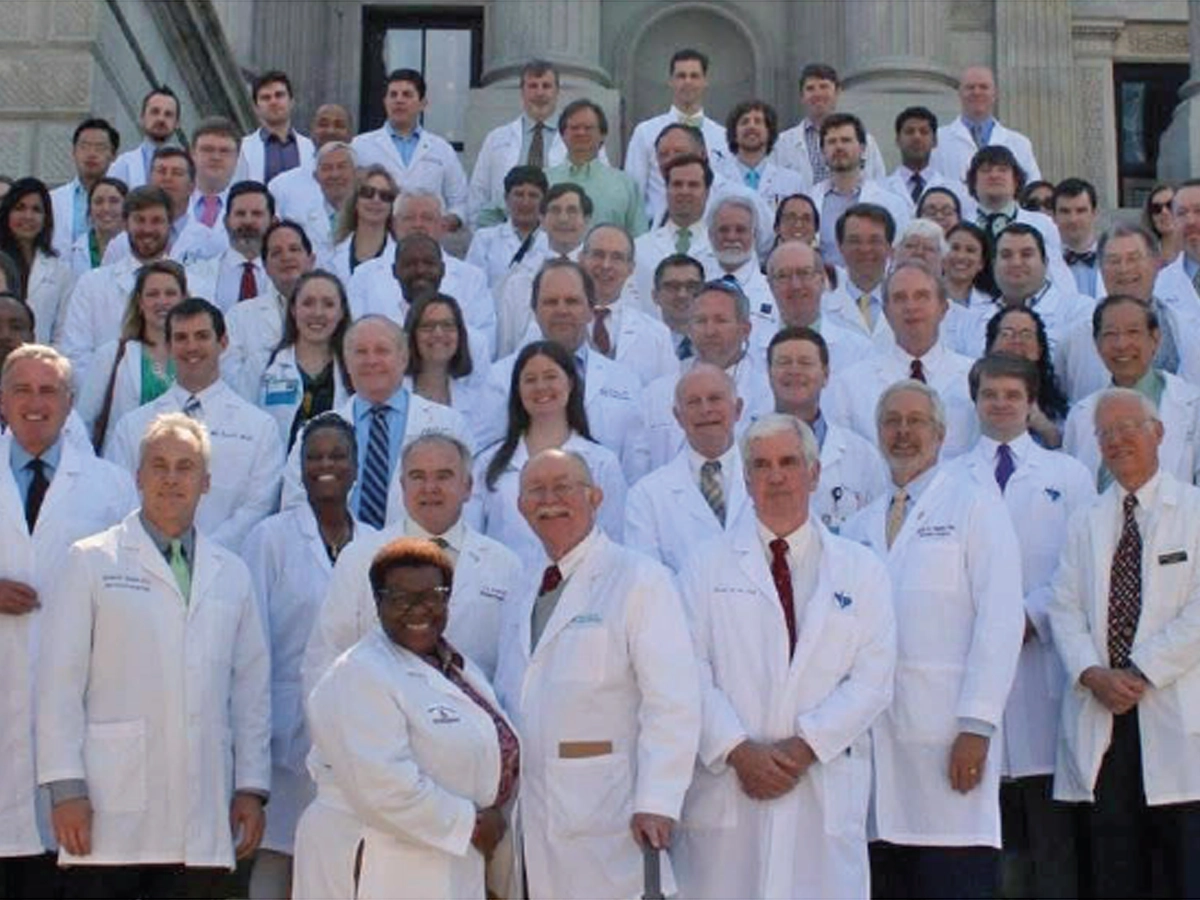
Storied Past; Passionate Voice; Bright Future
The unified voice of the physicians of the South Carolina Medical Association has proven integral to advancing medicine beyond individual practices and hospital walls. Together, SCMA physician leaders have improved the provision of medical care in South Carolina by establishing healthcare boards and regulatory bodies, and working with legislators to afford protections for their practices and for patients.
As we continue to advance healthcare delivery in South Carolina, it remains key to consider past successes throughout SCMA’s storied history as guides for the future. “While today’s physicians still want to make things better for their patients and their profession, they are often pulled in many ways seemingly more than the physicians in the past,” noted Dr. Tim Pearce, an SCMA past president. “We need to take inspiration from our predecessors. Together, we are stronger.”
DR. CAROL NICHOLS
A retired neurologist, Dr. Carol Nichols was proud to advance the voice of the woman physician when she joined the SCMA in the 1980s. She served as secretary in 1987 and subsequently held numerous Board of Trustees positions before becoming the organization’s first female president in 1996.
“I worked to legitimize feminism as a necessary and desirable commodity for the leadership of the medical profession and built on that during my tenure,” she noted.
When she entered “medical politics,” Dr. Nichols said, the looming issue was the development of managed care. The first broadreaching managed care organizations were developing and there was much posturing over who had authority and to what degree it would spread.
“There continues to be an open discussion about the autonomy of physicians in making decisions,” she said. The SCMA continues to advocate and represent the physician stance on this issue.
Maintaining organized medicine — from the county medical societies through the state organization and the American Medical Association (AMA) — perpetuates the profession through representation and recognition as a powerful voice that is respected when decisions are being made, she noted.
“Physician autonomy, the physician-patient relationship, and medical ethics have evolved over centuries,” she said. “Maintaining the integrity and the autonomy of the practicing physician and his relationship with the patient is still foremost in everyone’s mind.”
As an AMA delegate, Dr. Nichols attended national meetings and connected with key leaders. She caucused with Nancy Dickey, the AMA’s first woman president, and Regina Benjamin, future United States surgeon general.
“It opened my eyes to what was possible and what I could expect in the way of change,” she said. “I modeled myself to be successful in my career as a physician and to represent others.”
DR. TIM PEARCE
When Dr. Pearce joined the SCMA in 1984, he found himself amongst leaders of organized medicine, including over 150 physicians from across the state. It was shortly after his private general surgery practice opened, and many well-established physicians had suggested he get involved.
“As I sat in the back of the room, first time ever having been there to watch the leaders of the organization, it was really impressive to me,” he said. “It showed me the value of physicians getting together, learning from each other, to share the issues that we had in private practice.”
Dr. Pearce found inspiration from Dr. Walt Roberts, a former SCMA speaker of the house and later president, who would mentor him and many other young physicians.
“There were so many issues that came up that were important to physicians,” Dr. Pearce said. “Dr. Roberts would write about them; he would speak about them. The whole process drew me in and made me realize that there was so much to be learned.”
Before retiring in 2023, Dr. Pearce had served as president, secretary for three terms, chairman of the board for three years, and as an AMA delegate.
During his presidency, one of the main issues facing organized medicine was scope of practice, with non-physicians seeking to practice independent of physicians. The SCMA believes that nurse practitioners and physician assistants working in partnership with a physician are vital for healthcare delivery and efficiency. “However, we have been told that allowing nurse practitioners to be independent would place more providers in rural areas, but most studies have shown that is not the case,” he said.
Another success was the certificate of need battle which limited the addition of services and equipment in area hospitals based upon geographic proximity. The SCMA successfully rallied to allow independent physician practices to supplement income by having their own surgery centers and imaging centers.
“We were one of the few states able to make that happen, thanks to our lobbying team,” he said. “One of the main things that we do is to advocate for physicians and ultimately to help physicians take care of patients.”
DR. GERALD WILSON
When he joined the SCMA 40 years ago, Dr. Gerald Wilson took to heart an AMA president’s speech that stressed physician involvement in organized medicine should be a grassroots effort. From that point forward, the general and peripheral vascular surgeon relished in his involvement in SCMA, particularly with the judicial committee working on legislative issues affecting the practice of medicine.
Dr. Wilson navigated racial biases in representation, beginning with his service for the Columbia Medical Society, for which he served as president in 1995.
“I needed to be part of a system to get this attitude changed,” he said. He later held SCMA and AMA delegate positions as he moved forward with the statewide association. A frank discussion with the AMA CEO enabled Dr. Wilson to air issues related to African Americans and their practice of medicine.
As the state progressed and fostered inclusivity, Dr. Wilson rose to become the SCMA’s first black president in 2006. While presidents typically traveled to county association meetings to share statewide positions, he also used those meetings to listen and discuss how member concerns could be addressed.
“What was going on at the same time in medicine was a realization that we couldn’t look at it from a monochromatic lens,” he said.
“I felt it was necessary to represent physicians in South Carolina, but also to make sure the patients were being heard, that we were no longer a patriarchal society where the doctor just told the patient what to do. The way we improve healthcare is to have a partnership between patients and physicians.”
During Dr. Wilson’s presidency, scope of practice issues among specialties surfaced, with chiropractors, optometrists, and others desiring to expand their services beyond their training.
Dr. Wilson remains committed to advancing the voice of the practicing physician, whether independent or employed by a hospital or health system. All physicians need support with a variety of issues, including limitations on the time spent on individual patient visits as well as contracts for those in employed positions.
DR. JOHN EVANS
Dr. Evans was first introduced to the SCMA as a Doctor of the Day volunteer at the State House in 1996, providing medical coverage for legislators while in session. He also met lobbyists and organizational leaders and enjoyed learning about issues of concern to the state legislature.
The SCMA board needed a trustee from the Greenville area, and he was asked to serve the following year, continuing the work of past leaders and joining current physicians in advocating for the profession.
“We’re the only voice that all physicians have — surgeons, internists, all physicians collectively — we all have concerns about ethics and quality, and there is nobody else that represents that viewpoint,” Dr. Evans said.
By the time he ascended to president, the medical liability crisis was underway. Liability rates were rising precipitously as lawsuits and settlements were impacting physicians’ ability and desire to shoulder independent practices or even practice at all.
“Obstetricians stopped delivering babies because of liability settlements,” he said. “And it was a driver of physicians becoming employees rather than independent providers.”
With settlements growing out of proportion, Dr. Evans said, the SCMA undertook a multi-year effort to lobby for tort reform, capping non-economic damages awarded to patients. SCMA formed a coalition with the Medical University of South Carolina (MUSC) and a group from Florence County, and with the help of malpractice attorneys, formulated a plan that comprised the parties’ priorities.
SCMA leaders, led by Dr. Evans, took a grassroots approach to fighting this battle. Dr. Evans and other organizational leaders met with members of all 12 county medical societies, rallied and marched at the State House alongside AMA leaders, and took part in a televised debate with a liability attorney.
They aligned with legislators, Governor Mark Sanford, the Chamber of Commerce, newspaper editorial boards, and the AMA to protect physician practices from frivolous claims undertaken to elicit settlements from malpractice carriers. Ultimately, the landmark bill was signed during an outdoor ceremony at MUSC in Charleston on April 4, 2005.
“Spreading the message to government leaders unified us and ensured our voices were heard,” he noted. “We worked hard, we put in a lot of late hours, drove often to Columbia,” Dr. Evans said. “We had a big responsibility to show up, explain our position, and protect the physicians of South Carolina. It was a tremendous effort, but it was certainly worth it. We achieved what we set out to do.”
Malpractice reform remains an issue today, and continued advocacy work has limited the trajectory of premiums, he added.
Dr. Evans recalled the organization’s involvement in a successful multistate lawsuit against insurance companies. The suit was settled and changed the way insurance companies paid for care and put systems in place to correct their errors.
In addition, the organization began to offer services for physician members like health and liability insurance coverage, a benefit that was needed for the independent practitioner. Through regular communication, the SCMA also kept the members informed about key issues and happenings of note at the State House. Regular meetings and events enabled physicians to gather, share ideas, and build camaraderie as the organization grew in size.
DR. HELEN STOCKINGER
An internist in practice for more than 30 years, Dr. Stockinger has served the SCMA in a variety of roles, leading up to her presidency in 2023-24 and service as immediate past president last year.
Dr. Stockinger cites several priorities during her tenure, including defending the physician-patient relationship by opposing criminal penalties for physicians who discuss or provide abortions after six weeks. The SCMA also passed a resolution recognizing abortion as necessary medical care in certain circumstances and successfully advocated for removing mental health questions from the licensure renewal application.
Work on the noncompete clause repeal bill began during Dr. Stockinger’s tenure.
“This would be a huge win for physicians,” Dr. Stockinger said. “Currently a physician has to pick up and move away for a period of time as dictated by a noncompete clause. When a physician moves away, it disrupts patient care and the community loses a physician.”
In addition, she continued to advocate for physicians in the scope of practice battle, emphasizes the need to combat physician burnout, and kept the dialogue flowing amongst physicians and legislators.
THE ROLE OF THE STUDENT
With the streamlining of the SCMA annual meeting last year, medical students remain involved through poster presentations, proposing regulations, and holding Board of Trustee seats. SCMA leaders continue to work with area medical schools to keep students informed.
Jaimeen Shah was raised to serve others and developed a passion for advocacy while an undergraduate. In his third-year at MUSC, where he spent two years as medical school class president, he has embraced his calling with service to the U.S. Department of Health, the Charleston County Medical Society, and SCMA. Shah plans to continue policy work once he is a physician.
Shah initially connected with the SCMA during a first-year poster presentation and his involvement evolved to testifying before the Senate, providing a student voice in supporting legislation. He’s currently one of 150 medical students involved in the organization and worked on the scope of practice legislation effort, helping to coordinate a student letter of support from four medical school populations.
“While we are in the thick of our training, legislation now is going to affect how we practice in the future,” he said.
A BRIGHT FUTURE
With a legacy of more than 175 years, the SCMA has served as the unified voice of physicians from across South Carolina. We have united physicians, forwarded physicianled agendas, and advocated to advance the business of medicine.
SCMA established the state’s healthcare infrastructure to protect the sanctity of the physician-patient relationship, a key tenet of practice that remains at the core of healthcare today. The SCMA is proud to be the longest standing physician-led entity in the state, amplifying the voice of physician leaders to advance care while simultaneously ensuring that the physical and mental wellbeing of our patients always remain at the forefront of care.