
Caring Their Way
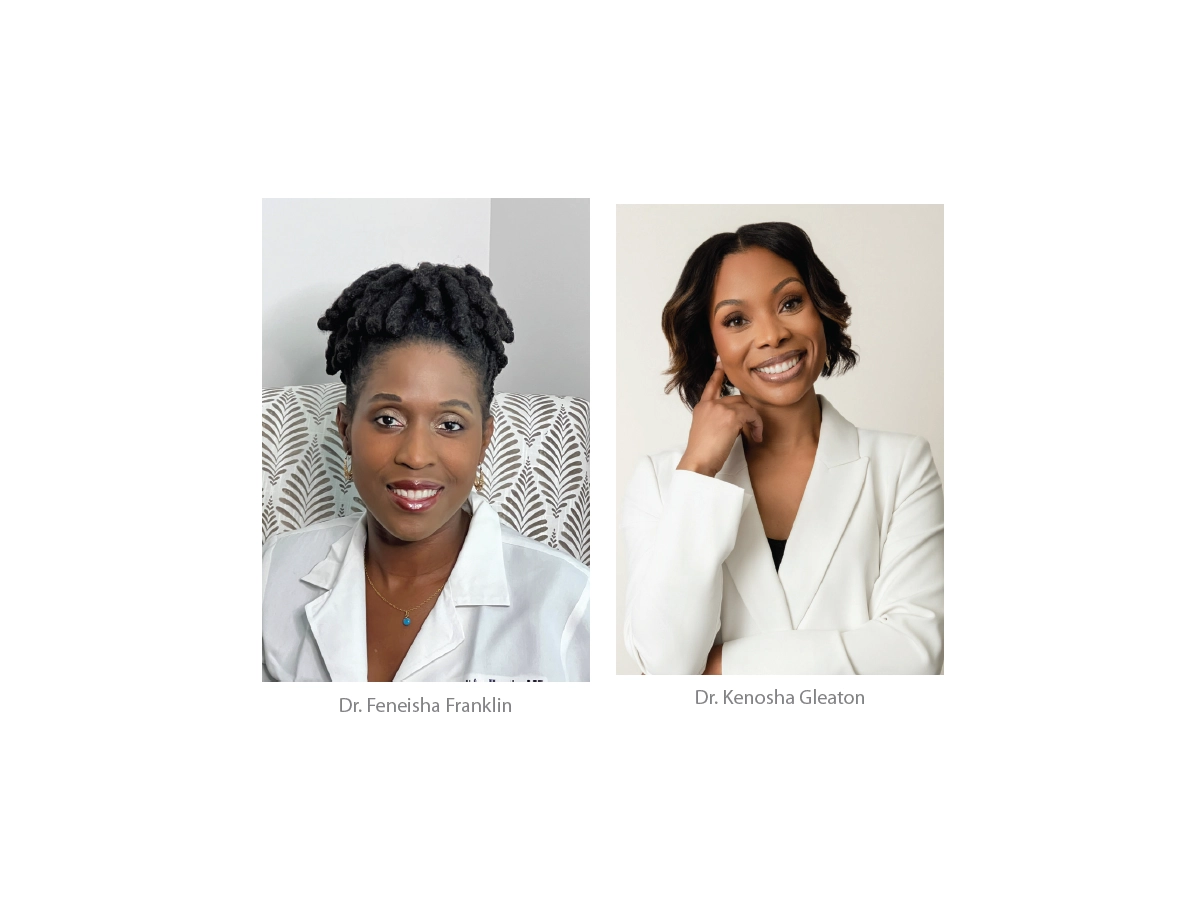
While in medical school at the University of Louisville, Dr. Feneisha Franklin spent a rotation shadowing a family practitioner in rural Kentucky. She witnessed the relationships he built with his patients, the trust they had in him and how he treated them with compassionate care, no matter how long the visit took.
That doctor carried a stack of index cards secured by a rubber band. He rarely referred to them, knowing each patient well enough to remember their medical history. If needed, he’d add a note in the corner.
“It was a beautiful experience,” said Dr. Franklin. “He related to his patients, and I felt like that made it different. They trusted him to treat them, regardless of their ailment. That’s what I aspired to.”
Dr. Franklin committed to family medicine at that time.
Clinical rotations also cemented the future for Dr. Kenosha Gleaton, an OB/GYN in private practice in Charleston. Dr. Gleaton’s interest in healthcare dates back to elementary school, when at 8-years-old, she read and reread a book on home remedies and made a hobby out of implementing them.
Once in middle school, she became fascinated with how the body changes during puberty. Another book proved to be a pager turner, not due to her own prepubescent hormones, but the intrigue about body changes. That was the prelude to a career devoted to women’s health, which was cemented following a clinical rotation in OB/GYN.
“It was almost like I was in a fantasy world,” she explained, comparing that rotation to a previous stint in pediatrics which didn’t resonate with her. “I felt like I was just talking to all of my best friends. It was just talking to only women. We always related, and I would look for unique ways to help them feel comforted in those visits, because a lot of anxiety goes into the pelvic exam… It was very clear to me that I just had to become an OB/GYN.”
ADAPTING THE DELIVERY MODEL
After 10 years in hospital-based care, both Dr. Franklin and Dr. Gleaton set out to open independent care practices with the goal of being more invested in their patients and spending more time with them. Both serve as the sole physician in the practice, relying on collaboration from employed advanced practice providers.
With her first mentor’s teaching in mind, Dr. Franklin purchased Living Well Family Medicine in Lexington last year, from Dee Carter, MD, a pioneer in direct primary care (DPC).
According to the American Academy of Family Physicians, under the DPC model, patients pay their physician or practice directly in the form of a flat monthly or annual fee, under terms of a contract, that covers primary care and medical administrative services without separate charges for office visits. For both concierge and direct primary care practices, patient panel sizes vary by physician. In general, practices with higher fees tend to have smaller patient panels, allowing for more time, access, and personalized care for each patient as they are not bound by insurance reimbursement restrictions. Dr. Franklin sees a daily caseload of about half the size of her previous practices.
Dr. Gleaton, like Dr. Franklin, spent the first decade of her career in a hospital-owned practice. When one of her patients was killed as a result of intimate partner violence, she vowed to practice differently, spending more time and providing expanded prenatal care centered on her patients. In tribute to her patient, she opened The EpiCentre, an all-inclusive OB/GYN practice, in Charleston in 2021.
Dr. Gleaton adopted the Centering Pregnancy method of care, a national model offering group prenatal care for women with similar due dates. In addition to measuring weights, vital signs, and fetal growth, the engaging two-hour visits provide educational components and a safe space for sharing concerns and asking questions. Educational components include serious topics like intimate partner violence and drug use in addition to standard guidance like what to expect at different stages of pregnancy.
“These women go through the pregnancy together in a fashion where they leave empowered, where they leave feeling that they own their pregnancy,” she said. “It’s a really empowering model and women love it. We have a 98 percent satisfaction rate for this model of care, and it’s been shown to decrease preterm labor and preterm delivery rates, decrease postpartum depression rates, and increase breastfeeding rates.”
Patients can opt for traditional care as well. All receive care at the spa-inspired center, which incorporates a philosophy of wholeness of mind, body, and spirit. Patients wear robes instead of paper gowns, and they enjoy food and drinks. They feel catered to in a peaceful environment.
“My mission is to ensure that every patient feels heard in a space that feels safe, and not feel judged, but feel supported,” Dr. Gleaton said.
While she does operate by accepting insurance, creativity enables her to pamper patients beyond normal OB/GYN care and also operate her practice the way she chooses.
“Being an independent provider made me become strategic in negotiating payer contracts, marketing the practice, and increasing our referrals,” she said. “It just made me think beyond my medical degree, and I think there’s value in that for the practice and our patients.”
ABOVE AND BEYOND
Similarly, Living Well provides niche services including reduced pricing for ancillary needs like medications and lab services.
During a recent physical, Dr. Franklin noticed impacted cerumen in a patient’s ear. Instead of sending him to an ENT, she offered irrigation in the office at that moment. The patient inquired about the cost.
“There’s no additional fee,” she said. “You’re our patient. It needs to be done.”
When a condition requires specialty care, Dr. Franklin refers out to professionals she’s previously worked with, not just names on a list. She equates her practice to that of a patient-centered medical home, where she serves as a partner with the patient and works directly with specialists to coordinate care. It’s the DPC model that allows her to be closely involved in all aspects of patient care.
“I would love for every physician to have the opportunity to work in direct primary care,” she said. “I love it.”
Dr. Gleaton also touts being patient-centric as one of the keys to building the provider-patient relationship.
“It allows me to do things that I wouldn’t be able to do ordinarily (like scanning a pregnant patient with a history of miscarriages on Mother’s Day), and it allows me to explore new opportunities to create a better healthcare experience for patients,” she said. “I absolutely believe that practicing as an independent strengthens the patient-doctor relationship, and I think that relationship is very sacred.”