
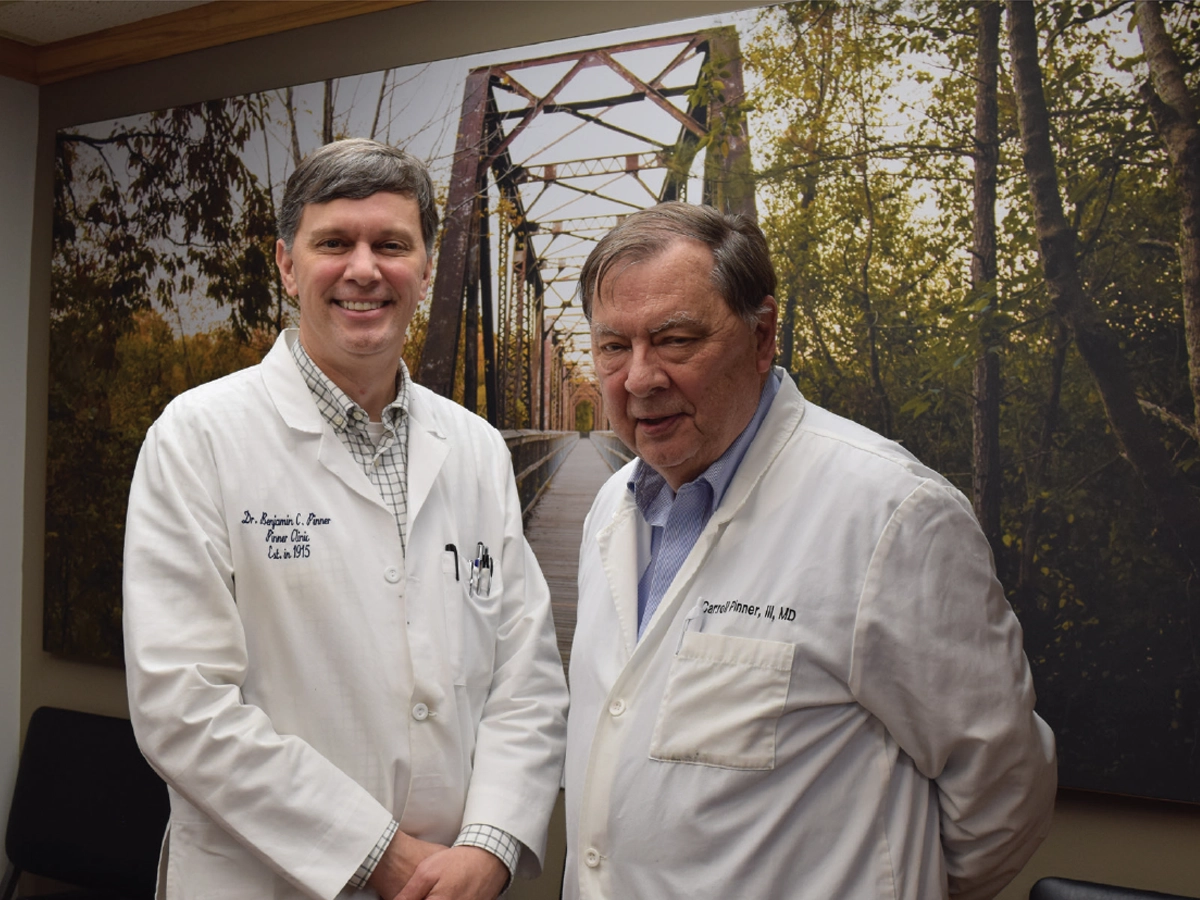
The Cornerstone of Peak for Four Generations
As a fourth-generation family practice nestled in the tiny rural town of Peak, the Pinner Clinic holds so many “remember when” stories that a book could write itself.
Dr. Carroll A. Pinner III, 80, remembers when his father headed out to make a house call on a dark night. Dr. Carroll Pinner Jr. was driving past the Parr Reservoir, when, as he approached a curve, as often happened, the headlights went out on his car. Normally remedied by pounding the dash, his usual treatment failed to work and off the road he went into the body of water.
“His car started to sink,” he recalled. “He crawled out of the window and thumbed a ride to the house call then later back home.”
He didn’t mention a word to his wife before going to bed.
The next morning, he and a friend returned to retrieve the submerged car. When they pulled it from the water, they discovered three sizable, perfectly good-for-eating catfish caught up in the haul — an inconvenience turned into supper, and just another story to add to the family lore.
The Pinner Clinic opened its doors in 1915. The town itself only counts approximately 60 residents now, but its sense of community stretches far beyond its size. In Peak, the clinic isn’t simply a medical practice; it is the town’s cornerstone. For births and vaccinations, well visits, hard conversations, and celebrations, generations of families have walked through the clinic’s doors — not just as patients, but as neighbors.
“Peak was established where the railroad crossed the Broad River before Columbia,” Dr. Benjamin “Ben” C. Pinner explained. “The railroad made it a thriving town. When trains no longer passed through, the community changed and, in many ways our practice keeps it thriving.”
Family members are active members of Mount Hermon Lutheran Church. “In fact, I’m the longest living lifelong member there – 80 years and still going,” said Dr. Carroll Pinner III.
The Pinners have been vestry members, they have helped with fundraising, served on the town’s recreation commission, and helped found The Peak Preservation Association.
“The impact of a thriving rural clinic reaches well beyond the office walls,” Dr. Ben Pinner explained.
“In the early 1900s, one third of my great grandfather’s patients were on the other side of the Broad River. At that time, there was no highway bridge crossing the river, so the only access to Fairfield County was the railroad trestle, which we now consider a symbol of our practice, a bridge to healthcare,” said Dr. Ben Pinner during a 2015 speech at the Pinner Clinic Centennial Celebration.
“In the early days, folks needing services sent a buggy to the opposite side and a man across the trestle to retrieve him. In the 1920s, he bought a Model T, as the first to own a car in the community, then later bought a second one to park across the river for house calls,” he continued. “His car across the river had to be moved when the water level would rise, and on one occasion when the flood waters were rising, he had a man swim in with a rope and tie his Ford to a tree to keep it from being swept away.”
When the highway 213 bridge was completed in 1961, it was dedicated to Dr. Carroll Pinner Sr.
The bridge reflected broader progress unfolding in Peak; then and now, the Pinner Clinic ushered patients through other historical changes in both the country and the practice of medicine. Vaccines, healthier foods, healthier mothers and babies, motor-vehicle safety, workplace safety, tobacco use, and declining deaths from heart disease and stroke – with each discovery and awareness campaign, the Pinner family mentored Peak residents and the surrounding communities.
The Peak community has given back to the Pinner family, too. When the Pinner Clinic burned to the ground twice – once in 1953, and again in 1978 – residents rallied. Patient records, carefully chronicled on 5×7 inch notecards and stored in fireproof containers, were spared both times.
“When the office caught fire in 1978, a reported 50 firefighters from three counties came to control the fire, and 15 fire departments responded. There was an outpouring of support from the community to rebuild, and they were back in business in one week. Everyone worked to clean, others to feed the workers,” wrote Dr. Ben Pinner’s cousin, Ellen Pinner (Pinny) Bowers, in an article for The Mid-Carolina Journal years ago.
“My aunt Mimi, who was in pharmaceuticals, was given instruments and other items by other physicians, donated to help the Pinner Clinic get reestablished,” Dr. Ben Pinner added. “There were unsolicited contributions made and an x-ray machine was donated. The actions of everyone served as a testament to what this family and this practice meant to the community.”
Today, the Pinner physicians have said goodbye to patient notes taken on notecards and integrated an AI dictation service that captures conversations with patients and integrates information into electronic medical records. That service does not capture information like which patient has a new grandchild, a new recipe, or a new tall hunting tale, so the Pinners often note those valuable tidbits on their own.
The practice has also welcomed revolutionary imaging techniques and testing options; however, many of the Pinner physicians confirm that a physical exam by Dr. Carroll A. Pinner III still reigns supreme.
“His physical exams are a lost art,” said Dr. Ben Pinner.
“When you’ve known your patients for generations, you can sense something is wrong when you walk in the room,” his father added. “You don’t need gadgets, you know. During the early years, especially in a rural clinic, one physician had to treat everything. You couldn’t see a specialist. You had to be a surgeon, ophthalmologist, obstetrician, and everything else.”
Dr. Ben Pinner also noted that his grandmother, Harriett Ellen Eidson Pinner, could easily be considered a pioneer for women in the field of medicine. “She was the only female in her class at the Medical University of South Carolina in the early 1940s. As a result, she was an easy and natural target.
“When she missed a few days of classes to have my father, a professor asked her why she had missed class,” he added. “Her response was, ‘Would you call having a baby a good excuse?’ He apparently had not noticed that she was pregnant, and after that he carried a chair around for her to sit down on hospital rounds.”
Dr. Carroll Pinner III is quick to note that without the clinic’s administrative staff, it would be tough, if not impossible, to keep the business open.
“We are so blessed to have our staff members. They keep the business side of medicine rolling,” he said. “Everything is so much more complicated, and there are quality measures to meet – they help us thrive. They enable us to maintain an independent practice.”
In fall 2026, the Pinner team will open a second location in nearby Little Mountain. They are already crafting job postings and they recognize that the individuals who join the family business will need to be as unique as the demands of a rural practice tend to be.
“The job requires more time, but the reward far exceeds the time invested,” said Dr. Ben Pinner. “As a family, we know that it is a privilege to do what we do. Patients trust us with their lives and decisions. It is an honor to guide them and to be appreciated.”
Dr. Ben Pinner’s wife, Jessica, offered an “outside” perspective. “I met this family as a pharmaceutical representative. The office felt like home immediately. It was, and it still is, filled with people who care about the community. They are not practicing for the money, but for the people who come here,” she said.
“This place is like no other,” Dr. Carroll Pinner III added. “There’s my version of an old country song that always comes back to me as ‘Lord, take me back to Peak, South Carolina – down by the Broad River where paradise lay.’ Everyone here gets to work and live here – in paradise.”
For more information about the Pinner Clinic and career opportunities there, contact Leigh Ann Randolph at Leighannr@pinnerclinic.com